
Health & Wellbeing
The Mental Infrastructure for Structural Resilience in NZ Workplaces

1. The Summer Reset: Why We Tune the Engine but Ignore the Driver
Every January, a familiar ritual plays out across Aotearoa. From the corporate hubs of Auckland’s CBD to the agricultural centres of the Waikato and the high-growth tech firms in Wellington, the "Summer Reset" takes hold. New Zealanders treat their bodies like high-performance assets - investing in gym memberships, new running shoes, and healthy meal kits - yet we often leave the driver, the mind, to navigate a volatile business landscape in a state of reactive chaos.
For the New Zealand business owner or HR manager, this disconnect is not just a personal hurdle; it is a measurable commercial risk. We set revenue targets, physical fitness goals, and market expansion KPIs, but we frequently neglect the psychological infrastructure required to achieve them. "Feeling better" is a vague aspiration, not a strategic plan. To transform your organisation’s results this year, you must move beyond surface-level wellness perks and install repeatable systems that allow the mind to thrive under the specific pressures of the New Zealand market.
2. The Commercial Case for Psychological Infrastructure in Aotearoa
The return on investment (ROI) for mental health is no longer a "soft" metric. Data shows that effective mental health initiatives in New Zealand provide a significant return on investment. This manifests in several key areas:
- Capturing Presenteeism:
This is the cost of staff who are at their desks but cognitively "checked out" due to stress. In New Zealand, presenteeism is estimated to cost businesses nearly double what is lost through actual sick days.
- Retention of High-Value Talent:
In our small, competitive labour market, losing a key staff member can stall a project for months. Resilience training reduces the "churn" that kills momentum.
- Legislative Duty of Care:
Under the Health and Safety at Work Act 2015 (HSWA), managing mental health risks is a primary legal duty. Implementing a structured support system is the strongly recommended way to meet your mandatory obligation to prevent psychological harm.
WorkSafe New Zealand Mandates
WorkSafe NZ has made it clear: psychological health now sits on equal footing with physical safety. Ticking a "wellness box" with a fruit bowl or a monthly yoga class is operationally insufficient. You need a structured approach to managing psychosocial risks - workload, lack of role clarity, and poor support. Building a mental blueprint is a core compliance requirement that protects your business from the high costs of workplace harm claims.
3. The Architecture of Change: Why "Big" is the Enemy of "Better"
A common mistake in strategic planning is focusing solely on the result rather than the framework needed to get there. Massive, sweeping resolutions - like "changing the company culture overnight" - usually fail because they lack the SMART criteria: Specific, Measurable, Achievable, Realistic, and Time-bound.
The Neurobiology of Resistance
To understand why "big" is the enemy of "better," we must look at how the human brain functions. The brain is hardwired for homeostasis - it loves the status quo because it is energy-efficient. Radical changes trigger a threat response in the amygdala, the brain's alarm system. When your team feels threatened by sudden, massive changes in process or expectations, their brains fight to return to old, even unhealthy, habits.
Small, incremental changes avoid this "alarm" response. They build muscle memory without overwhelming the internal system. For example, instead of a total digital overhaul, you might start by mandating ten-minute "cognitive resets" between back-to-back meetings. This creates lasting change through repetition rather than willpower.
4. Mastering Internal Control: The Manager’s Strategy
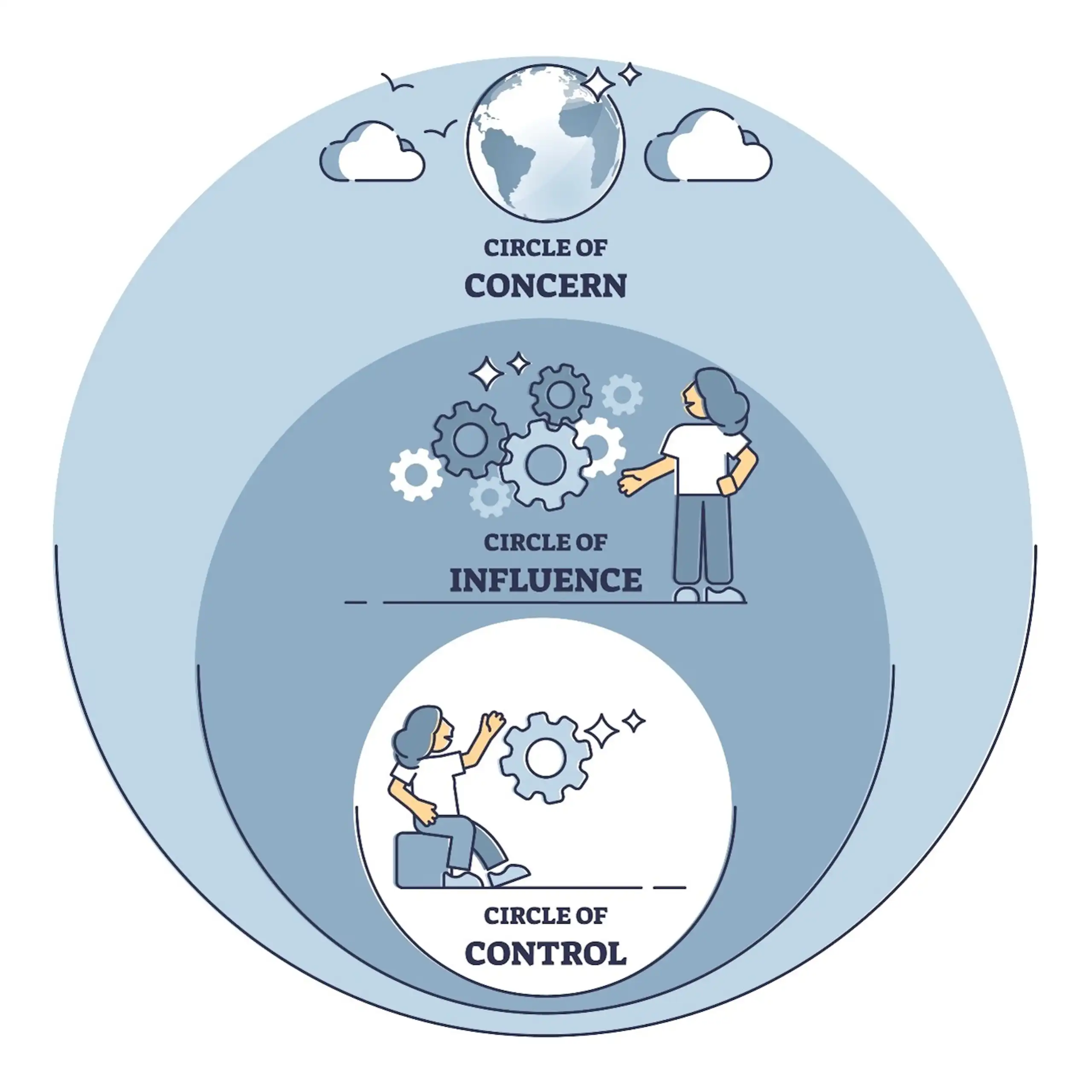
A key part of a manager’s strategy is mastering Internal Control. Nothing drains a team’s energy faster than "technostress" or obsessing over global variables they cannot influence - such as international interest rates or global supply chain volatility.
Real growth comes from setting emotional boundaries. It is about ensuring that external noise does not rattle your team's internal focus. By teaching your staff to focus only on what they can influence, you prevent burnout and keep their energy where it generates revenue. This focus on "influence over concern" is the hallmark of a resilient Kiwi workplace.
When these stacking techniques move from conscious effort to automatic routine, they fundamentally rewire your internal operating system. This transition from "doing" a habit to "embodying" a state creates a direct biological feedback loop, where each shift in your Mental State triggers a specific, measurable Professional & Physical Outcome:
- High Resilience
Sustainable high performance without the "burnout crash".
- Emotional Regulation
Constructive conflict resolution and better team cohesion.
- Cognitive Clarity
High Resilience Sustainable high performance without the burnout crash.
- Automated Self-Care
Automated Self-Care Consistent wellbeing regardless of workload spikes or deadlines.
5. The Mechanics of Habit Stacking and Automation
Consistency is the greatest hurdle to any new behaviour. To make a mental habit stick, you must reduce the "activation energy" required to start. We do this by moving away from "motivation" and toward "architecture."
1. The Strategy of Habit Stacking
Habit stacking involves pairing a new, desired behaviour with an existing one. This uses established neural pathways to build new habits with minimal effort:
- The Coffee Reset:
Practice a 60-second breath audit while the office coffee machine runs.
- The Meeting Anchor:
Incorporate five stretches or a moment of silence every time you finish an internal Zoom or Teams call. This signals a physical-to-mental reset.
- The Morning Audit:
Use your first cup of tea to perform a "Mental Audit." Ask: "What is my primary objective today, and is it within my circle of influence?"
2. Managing Decision Fatigue through Automation
By 5:00 PM, the part of the brain responsible for healthy choices - the executive function - is often exhausted. This is called decision fatigue. If you or your staff must decide to be resilient at the end of a long day, you will eventually fail. The secret is to take the decision out of the equation through automation:
- Digital Hygiene:
Set work phones to automatically silence notifications at 7:00 PM. This protects the brain’s recovery time without requiring a nightly act of willpower.
- Environmental Design:
Place visual anchors, like a written manifesto or a journal, in physical workspaces. These act as triggers that make healthy choices the "path of least resistance."


Build a resilient NZ workforce - request your free Wisdom Wellbeing demo today
6. The Synergistic Impact of a Managed Mind
When these systems are integrated, mental health ceases to be a "soft" cost centre and becomes a high-performance asset. A leader with high mental resilience possesses the emotional regulation required to maintain consistency under pressure.
The Myth of Passive Recovery
One of the biggest misconceptions in NZ business culture is that recovery is just the absence of work. We assume that "doing nothing" is the same as resting. However, scrolling social media often leaves the brain in a "Grey Zone" of low-level stimulation. This drains energy without providing any of the biological benefits of recovery.
True restoration requires Active Rest: activities that provide a "flow state" and recharge your cognitive battery far more effectively than "mindless" scrolling. This could be anything from a creative hobby to a focused walk in nature - anything that allows the brain to fully detach from work tasks
The Biological Bottom Line
When you manage your internal world, your physical and professional output improves. A resilient mind leads to lower cortisol levels, resulting in better sleep, higher energy, and a significant reduction in the "brain fog" that leads to costly workplace mistakes.
7. The HR Roadmap: A Stage-by-Stage Implementation
Stage 1: Leadership Transparency:
Culture is caught, not taught. Leaders must model the behaviour they expect. If a manager advocates for "The Right to Disconnect" but sends emails at 10:00 PM, the "Boundary Blueprint" is undermined. Leadership must demonstrate that cognitive recovery is a professional requirement, not a sign of weakness.
Stage 2: Management Training for Early Intervention:
Managers are the frontline of your health and safety strategy. They need the tools to spot the early signs of mental fatigue - such as withdrawal, increased errors, or irritability - before it turns into a long-term stress claim or a resignation. "Soft skills" are the "hard skills" of business survival.
Stage 3: The Digital Noise Audit:
Audit the amount of task-switching required in your business. Research shows that every interruption - a Slack ping, an email notification, a phone call - costs the brain significant time to refocus. Reducing unnecessary digital noise can improve the functional IQ across your team by up to 10 points.
Stage 4: Social Accountability:
Human beings are social creatures. We are far more likely to stick to a goal when we are part of a group. By verbalising a SMART goal to a trusted colleague or an EAP counsellor, you activate a psychological commitment that makes follow-through significantly more likely.
Turn HSWA 2015 duty into a measurable ROI - partner with NZ’s trusted EAP provider.
8. Reframing Failure as Diagnostic Feedback
The hesitation many decision-makers feel toward mental health initiatives often comes from a fear of "failing." We worry that if a staff member still burns out or a team remains stressed, the programme was a waste of money. In a high-performance culture, setbacks are not failures - they are diagnostic feedback. They show you exactly where your organisational processes need adjustment. Perhaps the workload is too high, or perhaps the communication channels are broken. Shifting from a mindset of "perfection" to one of "awareness" removes the stigma that stops people from seeking help early, allowing you to fix problems while they are still small and manageable.
9. Why the "Wait and See" Strategy is Failing
As we move further into the year, the pace of change is only accelerating. Between the integration of generative AI and the shifting economic landscape of the South Pacific, the "cognitive load" on your employees has never been higher. Businesses that wait until their staff are already burnt out to implement a mental strategy are essentially trying to build a fire extinguisher while the building is already on fire. Proactive psychological infrastructure is what separates the companies that scale from those that merely survive.
Conclusion: Architecting Sustained Resilience
The shift from vague resolutions to concrete systems is more than just a productivity hack; it is an act of commercial wisdom. We have spent far too long prioritising the "vehicle" - the external markers of success and fitness - while allowing the "driver" to operate in a state of perpetual exhaustion.
Your mental health is the foundation of every other business goal you have. Your revenue targets, your brand reputation, and your career milestones are only as valuable as your capacity to enjoy them with a clear and resilient mind. By implementing the SMART framework, utilising habit stacking, and designing an environment that supports your goals, you are doing more than just "trying to feel better." You are architecting a culture of sustained resilience. The map is in your hands. The GPS is set. It is time to take the wheel.
Empower Your Business’ Journey with Wisdom Wellbeing
Setting a vision for a resilient workplace is the first step; execution requires the right partner. Wisdom Wellbeing is a trusted EAP provider, delivering award-winning mental health and wellbeing solutions to organisations across New Zealand. Through the Wisdom Wellbeing’s employee assistance program, your team gains access to a comprehensive suite of tools designed for the working professional:
24/7 Helpline
Interactive Mood Tracker
Mini Health Checks
Four-Week Plans
And more
Is your organisation ready to support its greatest asset? Wisdom Wellbeing provides the clinical framework that reduces workplace stress and boosts productivity. Contact Wisdom Wellbeing today on 1800 868 659.
Don't just set a goal: build the system to achieve it.

Wisdom Wellbeing
Wisdom Wellbeing is one of Australia’s leading EAP providers. Specialising in topics such as mental health and wellbeing, they produce insightful articles on how employees can look after their mental health, as well as how employers and business owners can support their people and organisation. They also provide articles directly from their counsellors to offer expertise from a clinical perspective. Besides a focus on corporate wellbeing, Wisdom Wellbeing also caters to the needs of Aboriginal and Torres Strait Islanders. “Your trusted wellbeing partner”