
Health & Wellbeing
The Strategic Business Blueprint: Why Your Mind Needs a Structural Overhaul

1. The Strategic Disconnect: Why We Tune the Engine but Ignore the Driver
Imagine spending an entire year polishing, tuning, and upgrading a high-performance vehicle, only to leave the driver blindfolded behind the wheel. This is the reality of the traditional New Year resolution: a frantic rush to optimise the physical "vehicle" while leaving the mind to navigate life’s complexities in a state of reactive chaos.
For the Australian business owner or HR manager, this disconnect is more than just a personal hurdle. It is a measurable commercial risk. We are comfortable setting targets for our waistlines and our balance sheets, but we often forget to set a clear, measurable objective for our internal world. This is why so many resolutions fail by mid-February; they lack the psychological infrastructure to support them. "Feeling better" is not a plan: it is a destination without a GPS. If we want to truly transform our organisations and our lives this year, we must move beyond the surface. We need to focus on the daily routines and repeatable systems that allow the mind to thrive, rather than just survive.
2. The Commercial Reality of the Australian "Mindset Gap"
Why should a decision-maker care about "internal blueprints" in 2026? Because the Australian workforce is currently facing a silent productivity leak. Recent data from the Productivity Commission and Safe Work Australia suggests that untreated mental health conditions cost our economy up to $39 billion every year.
The ROI of a Resilient Workforce
The numbers are hard to ignore. For every dollar an Australian business invests in creating a mentally healthy workplace, there is an average return on investment of $2.30. It comes from reduced absenteeism, lower staff turnover, and a massive drop in "presenteeism" - where staff are at their desks but functionally checked out due to stress.
The Legislative Mandate
Under the Work Health and Safety (WHS) laws in Australia, psychological health is now on equal footing with physical safety. Regulators are no longer satisfied with a "wellness box" being ticked. They want to see that businesses have a structured approach to managing psychosocial risks like workload, low job control, and poor support. Building a mental blueprint for your team is no longer just "nice to have": it is a core compliance requirement.
The Economic Reality of "The Productivity Leak"
- Presenteeism Costs:
Employees who are mentally overextended but physically present cost Australian businesses nearly double what is lost through actual sick days.
- The ROI of Proactivity:
Research shows that for every $1 invested in effective workplace mental health strategies, businesses see a return of at least $2.30 in reduced absenteeism and higher engagement.
- The Talent War:
In 2026, 36% of Australian workers report that they would choose a workplace with robust mental health support over a 10% salary increase.
By combining the science of habit formation with emotional resilience, we move beyond surface-level perks like fruit bowls and gym discounts. We focus on the practical mechanics of grit and routine to build a workplace culture that truly thrives where it matters most.
3. The Architecture of Change: Why "Big" is the Enemy of "Better"
A common mistake in January planning is focusing solely on the result rather than the structural framework required to get there. When we set massive, sweeping resolutions, they usually lack the "SMART" criteria: Specific, Measurable, Achievable, Realistic, and Time-bound. Without these guardrails, a resolution quickly becomes a mountain that feels impossible to climb.
The Brain’s Resistance to Radical Change
Behavioural science tells us that our brains are hardwired for homeostasis - a fancy way of saying they love the status quo. When you try to make radical changes overnight, your brain perceives it as a threat and fights to return to your old habits, even if those habits are unhealthy. Small changes, however, do not trigger this "alarm" response. They are like ripples in a pond: starting small but expanding with a bigger impact as they move further into your life. Something as simple as walking an extra 100 steps or getting off the bus one stop early builds "muscle memory" without overwhelming your internal systems.
Mastering Internal Control
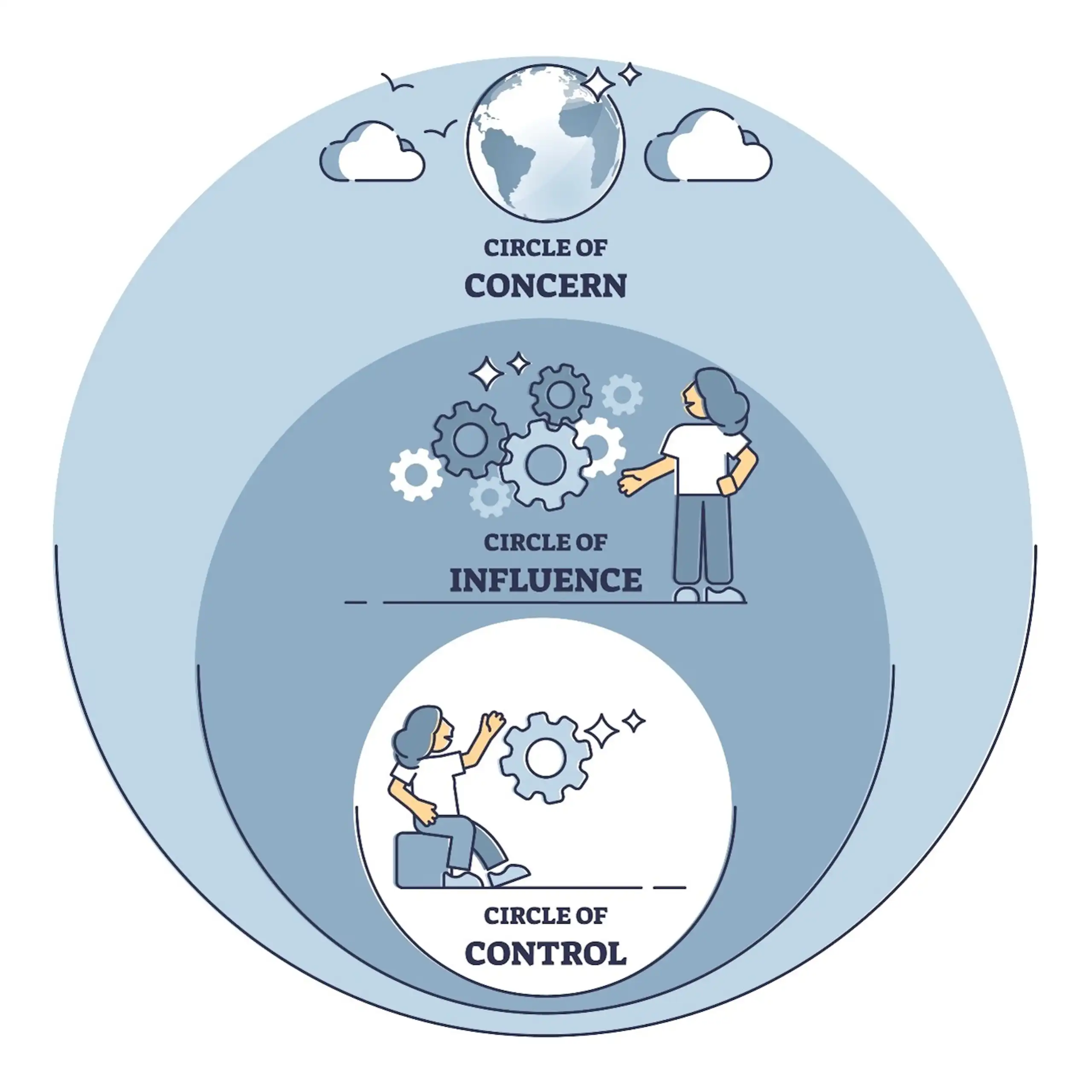
A key part of managers’ strategy for the year is to master "Internal Control." Nothing drains a team faster than "technostress" or obsessing over global shifts they cannot change. Real growth and resilience come from setting emotional boundaries - ensuring that external noise like interest rates or market fluctuations does not rattle your internal focus. By focusing only on what you can influence, you prevent burnout and keep your team's energy where it counts.
4. The Mechanics of Habit Stacking and Micro-Wins
Consistency is the greatest hurdle to building any new behaviour. To make a new habit stick, it is vital to reduce the "activation energy" required to start. One of the most effective ways to do this is through Habit Stacking. Pairing a new behaviour with an existing one allows you to use established neural pathways to build new habits automatically.
- Mindfulness Stacking:
Practice a 60-second breathing exercise while the office kettle is boiling or while waiting for a microwave to beep.
- • Movement Stacking:
Incorporate five squats or stretches every time you finish an internal Zoom call, building a physical-to-mental reset into your workflow.
- Cognitive Checking:
Use your first cup of tea to perform a "Mental Audit." Ask: "What is my primary objective today, and is it within my circle of influence?"
When these stacking techniques move from conscious effort to automatic routine, they fundamentally rewire your internal operating system. This transition from "doing" a habit to "embodying" a state creates a direct biological feedback loop, where each shift in your Mental State triggers a specific, measurable Professional & Physical Outcome:
- High Resilience
Sustainable high performance without the "burnout crash".
- Emotional Regulation
Constructive conflict resolution and better team cohesion.
- Cognitive Clarity
Faster problem-solving and a reduction in "presenteeism."
- Automated Self-Care Consistent protection of wellbeing regardless of workload.
5. Overcoming Obstacles: Reframing Failure and Decision Fatigue
The hesitation many decision-makers feel toward mental health initiatives often comes from a fear of "failing." If a staff member has a "bad day," the initiative has not failed. In a high-performance culture, setbacks are viewed as diagnostic feedback. They provide information on where your organisational processes need adjustment. Shifting the objective from "perfection" to "awareness" removes the stigma that stops people from seeking help early.
Decision Fatigue and Automation
One of the primary reasons mental health resolutions fails is decision fatigue. Every day, we make thousands of choices, and by 5:00 PM, our "executive function" - the part of the brain responsible for healthy choices - is exhausted. If you must decide to be mindful or decide to journal, you will eventually run out of steam. The secret to long-term well-being is to take the "decision" out of the equation through automation. This involves setting intentions that are time-bound and linked to physical triggers, turning self-care into a reflex.


Stop the productivity leak, automate your team’s mental resilience with Wisdom Wellbeing
6. The Power of Environment Design
Our physical and digital environments act like invisible hands that shape our behaviour. If your goal is to reduce stress, but your digital space is a constant barrage of high-urgency notifications, you are fighting a losing battle against your own biology. To turn a vague intention into a repeatable habit, you must proactively design your environment to support your goals rather than work against them.
- *Digital Hygiene: *
Silence work notifications at a set time every evening to protect the brain's biological engine.
- Physical Anchors:
Keep a journal on your pillow or a written manifesto on your desk. These serve as a constant visualisation of future goals, providing daily motivation when the initial January excitement fades.
7. The Synergistic Impact of a Managed Mind
If these systems are integrated, the results are both biological and financial. The mind and body are a singular system. A leader with high mental resilience does not just "feel better": they possess the emotional regulation required to maintain consistency under pressure.
The Myth of Passive Recovery
A common pitfall is the belief that recovery is a passive process - simply the absence of work. True mental restoration often requires active engagement. While scrolling social media might feel like rest, it often leaves the brain in a state of "Grey Zone" stimulation. The "Grey Zone" is a psychological middle ground where you are not fully working, but you are not fully resting either. This low-level stimulation drains your energy without providing benefits, leading to further fatigue.
Active Rest Strategies for this Year:
- The Boundary Blueprint:
Implement a "Right to Disconnect" policy that truly silences work-related apps after hours, protecting the biological engine of the brain.
- The Education Blueprint:
Invest in psychoeducation for managers so they understand the neurobiology of stress, moving from emotional reaction to logical leadership.
- The Self-care Blueprint:
Schedule monthly professional check-ins to treat mental health with the same rigour as a financial audit or a physical health check.
The Biological Bottom Line: When you manage your internal world, your physical output improves. A resilient mind leads to lower cortisol levels, which results in better sleep, higher energy, and a significant reduction in the "brain fog" that leads to costly workplace mistakes.
Build a high-performance mental architecture, request your free Wisdom Wellbeing demo today
8. The Ultimate High-Performance Strategy
The shift from vague resolutions to concrete systems is more than just a productivity hack: it is an act of radical self-respect. We have spent far too long prioritising the "vehicle" - the external markers of success and fitness - while allowing the "driver" to operate in a state of perpetual exhaustion and fog.
As you navigate the year ahead, remember that your mental health is the foundation upon which every other goal is built. Your biceps, your bank account, and your career milestones are only as valuable as your capacity to enjoy them. By implementing the SMART framework, utilising habit stacking, and aligning your daily actions with your deepest values, you are doing more than just "trying to feel better." You are architecting a life of sustained resilience. The map is in your hands, the GPS is set, and the fog is beginning to lift. It is time to take the wheel.
9. Implementing The HR Roadmap for the Year
To reach peak organisational performance, we need to break the plan down into departmental actions:
- Leadership Transparency:
Leaders must model the behaviour. If a manager advocates for "The Right to Disconnect" but sends emails at 10:00 PM, the system breaks.
- Middle Management Training:
Managers are the frontline. They need the tools to spot "Presenteeism" early - before it turns into a long-term stress claim.
- Digital Hygiene Standards:
Audit the "digital noise" in your business. Reducing unnecessary task-switching between platforms can improve functional IQ across the team by up to 10 points.
- Social Accountability:
Human beings are social creatures. When you verbalise your "SMART" goals to a trusted colleague or an EAP counsellor, you activate a psychological commitment that makes you far more likely to follow through.
10. Empower Your Business Journey with Wisdom Wellbeing
Setting mental health intentions is a powerful first step, but the right support can be the difference between a temporary wish and a permanent change. Wisdom Wellbeing is Australia's leading EAP provider, delivering award-winning mental health and wellbeing solutions to over 88,000 organisations worldwide.
Through Wisdom Wellbeing’s EAP program, you have the ultimate companion for your mental health systems including 24/7 Helpline with immediate access to our clinical team, interactive mood tracker, mini health checks, four-week plans and more.
Is your organisation ready to support its greatest asset? Wisdom Wellbeing provides clinical excellence that reduces workplace stress and boosts productivity by providing employees with the tools they need to flourish. Contact Wisdom Wellbeing today at 1800 868 659 to request a free demo and discover how the Wisdom App and our comprehensive EAP services can transform your team's mental architecture.
Don't just set a goal: build the system to achieve it.

Wisdom Wellbeing
Wisdom Wellbeing is one of Australia’s leading EAP providers. Specialising in topics such as mental health and wellbeing, they produce insightful articles on how employees can look after their mental health, as well as how employers and business owners can support their people and organisation. They also provide articles directly from their counsellors to offer expertise from a clinical perspective. Besides a focus on corporate wellbeing, Wisdom Wellbeing also caters to the needs of Aboriginal and Torres Strait Islanders. “Your trusted wellbeing partner”
Latest articles

Health & Wellbeing article
The Day Two Defeat: A Clinical Guide to Breaking the Shame Spiral and Reclaiming Your Year
Read more
Health & Wellbeing article
The Strategic Business Blueprint: Why Your Mind Needs a Structural Overhaul
Read more

Health & Wellbeing article
New Year, New Mind: The Strategic Resolution Your Business Needs
Read more