Legal
Victoria’s Psychological Health Regulations 2025: Employer Compliance Checklist

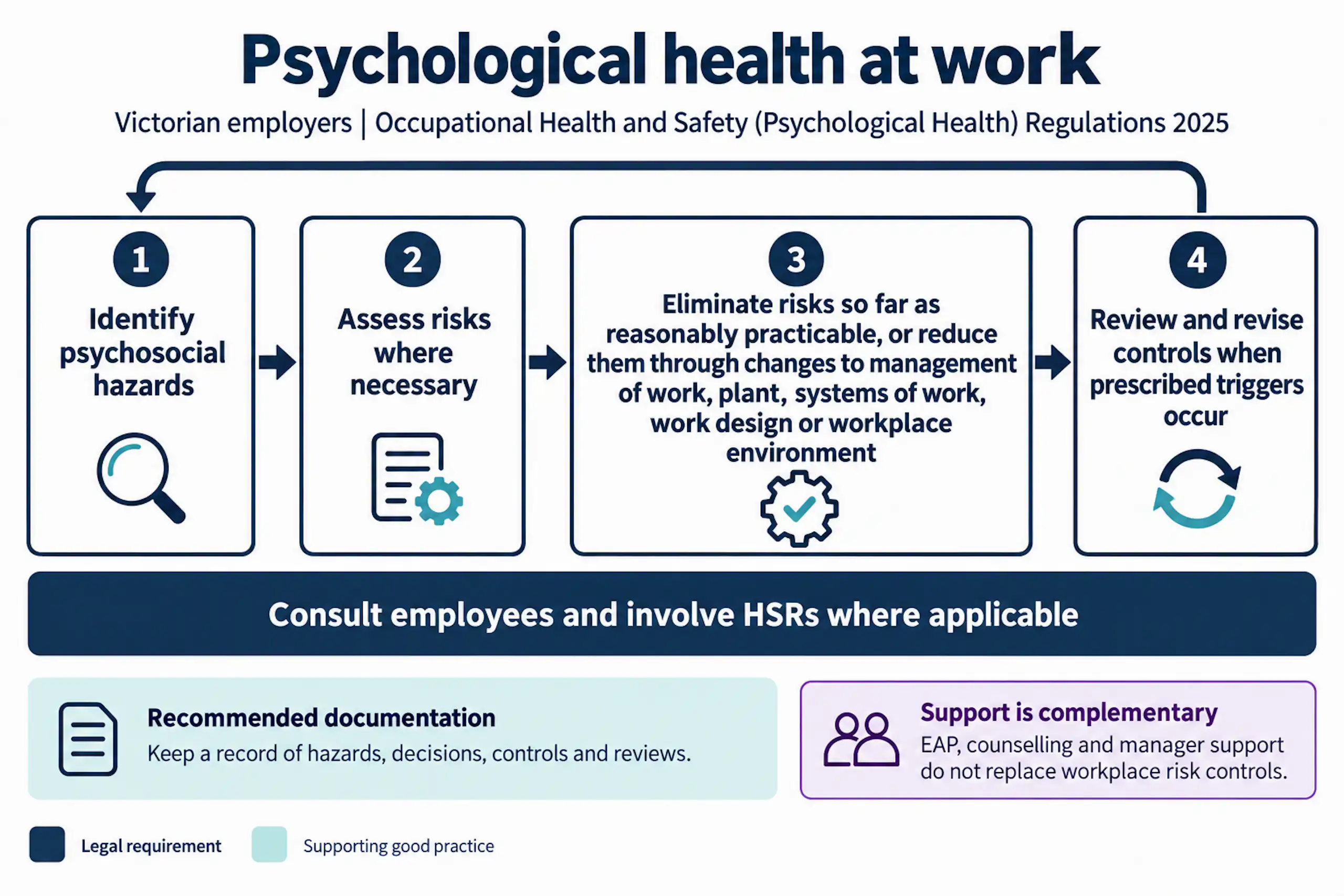
The Occupational Health and Safety (Psychological Health) Regulations 2025 commenced in Victoria on 1 December 2025. Victorian employers must identify psychosocial hazards, eliminate associated risks so far as is reasonably practicable, reduce risks where elimination is not reasonably practicable, consult affected employees and relevant Health and Safety Representatives, and review controls when specified events occur.
In simple terms:
Victorian employers must manage psychological health using the same risk-management discipline applied to physical health and safety. The focus should be on addressing unsafe working conditions, not simply asking employees to become more resilient to them.
These requirements apply across Victorian workplaces. The process can be proportionate to the organisation’s size, structure and risk profile, but psychological health must be considered as part of workplace health and safety.
Important:
An Employee Assistance Program (EAP) can provide valuable support to employees and managers, but it does not replace an employer’s responsibility to identify and manage psychosocial risks arising from work.
What should Victorian employers do now?
If your organisation has not yet reviewed its approach to psychosocial risk, start with these five actions.
1. Identify the conditions that may cause psychological harm
Look beyond individual wellbeing and examine workloads, staffing, role clarity, support, workplace relationships, organisational change and exposure to aggression or traumatic events.
2. Consult employees and relevant Health and Safety Representatives
Ask how work is experienced in practice, not only how policies say it should operate.
Employees can provide important information about workload pressures, unclear responsibilities, poor support and risks that may not be obvious from organisational data.
3. Review existing controls
Check whether existing controls address the source of the risk.
Resilience training, wellbeing initiatives and counselling can support employees, but they do not correct excessive workloads, unsafe staffing, poor work design or harmful workplace behaviour.
4. Assign responsibility and review dates
Record what needs to change, who is responsible for implementing the control and how the organisation will determine whether the change has reduced the risk.
5. Separate workplace risk controls from employee support
Workplace controls should address the hazard itself. Services such as an EAP can sit alongside those controls by giving employees and managers access to confidential professional support when they need it.
What are Victoria’s Psychological Health Regulations?
The Occupational Health and Safety (Psychological Health) Regulations 2025 strengthen Victoria’s existing occupational health and safety framework by establishing specific requirements for managing psychosocial hazards and associated risks.
Victoria operates under its own occupational health and safety legislation. Victorian employers should therefore refer to the Victorian OHS Act, the Psychological Health Regulations and guidance from WorkSafe Victoria rather than assuming model WHS requirements apply unchanged.
WorkSafe Victoria has also published a Psychological Health Compliance Code providing practical guidance for people and organisations with duties relating to psychological health and psychosocial hazards.
The Compliance Code is not itself legislation. However, WorkSafe Victoria explains that a duty holder who complies with the Code will, to the extent that it deals with the relevant duties or obligations, be taken to have complied with them. A duty holder may comply another way, but failure to observe the Code may be used as evidence in proceedings.
Who must comply with Victoria’s Psychological Health Regulations?
The regulations apply to Victorian employers.
For business owners, HR teams and workplace leaders, this means psychological health must be managed as part of workplace health and safety, not treated only as an employee wellbeing initiative or left until an employee becomes unwell.
The process used to manage psychosocial risks can be proportionate to the size and complexity of the workplace, but employers still need to understand the hazards arising from their work and take reasonably practicable steps to control the associated risks.
WorkSafe Victoria has developed Psychological Health Basics specifically to help small and medium Victorian businesses understand their OHS responsibilities relating to psychological health.
Relevant OHS duties can also apply in situations involving independent contractors and labour-hire arrangements, depending on control over the relevant work or workplace.
Ready to support your workforce?
What counts as a psychosocial hazard?
Under the Occupational Health and Safety (Psychological Health) Regulations 2025, a psychosocial hazard can arise from work design, systems of work, management of work, the way work is carried out or personal and work-related interactions that may result in a negative psychological response and create a health or safety risk.
WorkSafe Victoria identifies examples including:
- Aggression or violence
- Bullying
- Exposure to traumatic events or content
- Gendered violence
- High job demands
- Low job control
- Low job demands
- Low recognition and reward
- Low role clarity
- Poor environmental conditions
- Poor organisational change management
- Poor organisational justice
- Poor support
- Poor workplace relationships
- Remote or isolated work
- Sexual harassment
This list is not exhaustive.
Employers also need to consider how hazards interact. For example, high job demands combined with low job control and poor support can increase the likelihood and severity of harm.
For a broader explanation of workplace hazards and prevention strategies, read Wisdom Wellbeing’s guide to preventing psychosocial hazards at work.
What must Victorian employers do?
The regulations establish an ongoing risk-management process rather than a one-off compliance exercise.
1. Identify psychosocial hazards
Employers must identify psychosocial hazards so far as is reasonably practicable.
WorkSafe Victoria’s guidance on identifying psychosocial hazards explains that employers should consider their organisational context, the work being performed and how hazards may affect different employees, workgroups or workplaces.
Sources of information may include:
- Employee consultation
- Workplace observations
- Hazard and incident reports
- Complaints and grievances
- Workload and rostering information
- Organisational changes
- Employee feedback
- Discussions with Health and Safety Representatives
Employers should not wait until psychological harm has occurred before examining conditions in their workplace.
2. Assess psychosocial risks where necessary
Employers should assess psychosocial risks when they need to understand the seriousness of a risk or determine which controls may be appropriate.
According to WorkSafe Victoria’s psychosocial risk assessment guidance, an assessment may be appropriate where:
- It is unclear whether a psychosocial hazard may result in harm
- It is unclear how different hazards may interact
- Existing risk controls are not effective
- Planned workplace changes may affect existing controls.
Employers should consider:
- Likelihood of exposure
- Frequency of exposure
- Duration of exposure
- Potential severity of harm
- Employees who may be particularly exposed
- The combined effect of multiple psychosocial hazards.
WorkSafe Victoria also states that risk assessments must involve consultation with employees and any HSRs so far as is reasonably practicable.
For more detail on assessment approaches, see Wisdom Wellbeing’s guide to psychosocial risk assessment tools in Australia.
3. Eliminate or reduce psychosocial risks
Once a psychosocial risk has been identified, employers must first consider whether it can be eliminated so far as is reasonably practicable.
Where elimination is not reasonably practicable, the employer must reduce the risk so far as is reasonably practicable.
WorkSafe Victoria’s guidance on controlling psychosocial risks identifies controls involving changes to:
- Management of work
- Plant
- Systems of work
- Work design
- Workplace environment.
Information, instruction or training may also form part of the response, and a combination of measures may be necessary.
This distinction matters.
If excessive workloads are creating a psychosocial risk, resilience training does not change the workload.
The employer may need to examine:
- Staffing levels
- Rostering
- Deadlines
- Work allocation
- Responsibilities
- Available resources
- Breaks and working hours
- Escalation and support arrangements
WorkSafe Victoria states that information, instruction or training may only be used exclusively where the other specified types of control are not reasonably practicable. Where measures are combined, information, instruction or training must not be the predominant control.
4. Consult employees and Health and Safety Representatives
Consultation is a core part of psychosocial risk management.
Employees can provide information about how work actually operates, where pressure occurs and whether proposed controls are likely to work in practice.
Consultation may be required when:
- Identifying psychosocial hazards
- Assessing risks
- Deciding how risks will be controlled
- Considering relevant workplace changes
- Reviewing existing controls
Where employees are represented by an HSR, the HSR should be appropriately involved in the consultation process.
The approach can reflect the organisation’s size and structure.
A small business may use team discussions and individual conversations. Larger organisations may need employee surveys, focus groups, HSR consultation and processes across different locations and workgroups.
WorkSafe Victoria emphasises consultation throughout the Psychological Health Compliance Code.
5. Review and revise psychosocial risk controls
Managing psychosocial risk does not finish once a control has been introduced.
Under WorkSafe Victoria’s guidance on reviewing psychosocial risk controls, controls must be reviewed in specified circumstances, including:
- Before a change likely to alter psychosocial risk
- When new or additional information about a hazard becomes available
- When an employee, or someone acting on the employee’s behalf, reports a psychological injury or psychosocial hazard
- Following a relevant notifiable incident involving a psychosocial hazard
- When existing controls are not adequately controlling the risk
- Following a qualifying request from an HSR.
Where the review shows that controls are inadequate, they must be revised.
Is a psychosocial prevention plan mandatory in Victoria?
No.
WorkSafe Victoria provides a prevention-plan template that employers can use to guide and document the psychosocial risk-management process.
The important distinction is between the legal duty and the tool used to document it.
Employers must meet their risk-management and consultation obligations. Completing a particular template does not replace those duties.
Useful records may include:
- Identified hazards
- Employees, roles or locations potentially affected
- Consultation undertaken
- Risk assessments
- Decisions about controls
- People responsible for implementing controls
- Review dates
- Outcomes of control reviews
- Relevant induction and training records


Strengthen support across your workplace
Victorian employer psychological health compliance checklist
Use this as a practical starting point for reviewing your organisation’s current approach.
Legal requirements
Check whether your organisation has:
- Identified psychosocial hazards so far as is reasonably practicable
- Consulted employees who are or may be affected
- Involved relevant HSRs where applicable
- Considered whether identified risks can be eliminated
- Reduced risks where elimination is not reasonably practicable
- Considered changes to work, systems, management or the workplace when selecting controls
- Properly implemented and maintained risk controls
- Reviewed controls when required
- Revised controls that are not adequately controlling the risk
- Considered existing incident-notification obligations following a relevant notifiable incident.
Recommended supporting actions
Employers may also benefit from:
- Recording identified hazards and affected roles or workgroups
- Documenting employee and HSR consultation
- Recording how employee feedback influenced decisions
- Assigning responsibility for each control
- Setting review dates
- Maintaining clear psychosocial hazard reporting pathways
- Keeping relevant induction and training records
- Using WorkSafe Victoria’s prevention-plan template where useful
- Checking whether a control creates new risks elsewhere
- Seeking specialist OHS or legal advice where an obligation or risk is unclear
Risk controls and employee support perform different roles
Workplace controls should address the conditions creating psychosocial risk. Employees and managers may still need confidential professional support while those risks are being addressed or following a difficult workplace event.
Wisdom Wellbeing’s Employee Assistance Program gives employees access to 24/7 confidential counselling from PACFA and ACA-accredited professionals. Manager Assist provides leaders with guidance for workplace and wellbeing concerns, while Critical Incident Support provides assistance following distressing workplace events.
An EAP does not replace workplace risk controls. It provides a professional support pathway alongside the organisation’s broader psychological-health approach.
Explore Wisdom Wellbeing’s Employee Assistance Program.
What should small businesses review first?
Small businesses do not need to create an unnecessarily complicated system.
Start by looking at the work itself.
Consider:
- Are workloads reasonable?
- Do employees understand their responsibilities?
- Do employees have appropriate control over aspects of their work?
- Do managers provide adequate support?
- Are employees exposed to aggressive customers or clients?
- Does anyone regularly work alone or remotely?
- Are workplace conflicts being addressed?
- Are organisational changes communicated and managed appropriately?
WorkSafe Victoria specifically offers Psychological Health Basics for Victorian small and medium businesses.
Talk to employees about what is working and what is creating pressure. Record agreed actions, assign responsibility and check whether those actions actually reduce exposure to the hazard.
What should HR and People teams review first?
HR and People teams should avoid treating psychosocial risk as a separate wellbeing initiative.
Look across existing organisational information, including:
- Employee complaints and grievances
- Absence patterns
- Employee feedback
- Organisational change
- Workload concerns
- Bullying or harassment reports
- Manager capability
- Exit feedback
- Workplace incidents
The objective is to determine whether these signals indicate hazards arising from how work is designed, managed or carried out.
Psychosocial risk management should then connect with the organisation’s wider OHS processes rather than sitting only within employee wellbeing.
What should larger or multi-site employers review first?
Larger organisations should consider whether psychosocial risks differ between:
- Locations
- Teams
- Roles
- Shifts
- Business units
- Frontline and office-based employees
- Remote and on-site workers
WorkSafe Victoria advises employers to consider whether one risk assessment adequately covers common hazards or whether separate assessments are required for particular teams, work areas, locations or designated workgroups.
A company-wide result can otherwise hide significant risks within a particular group.
Larger employers should also establish clear responsibility for:
- Identifying hazards
- Consulting employees
- Implementing controls
- Escalating concerns
- Reviewing controls
- Monitoring whether controls remain effective
Where does an EAP fit into Victoria’s psychological health requirements?
An Employee Assistance Program can give employees confidential access to professional support and provide managers with guidance when difficult workplace situations arise.
EAP support may help when employees are experiencing:
- Stress
- Workplace conflict
- Personal difficulties
- Mental health concerns
- The effects of a distressing workplace event
WorkSafe Victoria gives EAP access and peer support as examples of potential post-incident support within a broader combination of controls.
However, an EAP is not a replacement for controlling psychosocial risks at their source.
Counselling may support an employee affected by excessive workloads, for example, but the organisation must still consider whether workload, staffing, working hours, resources or work design need to change.
Similarly, an EAP does not remove the need to address:
- Bullying or harassment
- Unsafe staffing arrangements
- Poor role clarity
- Inadequate support
- Harmful workplace relationships
- Poorly managed organisational change
- Other hazards arising from work
Wisdom Wellbeing’s Employee Assistance Program provides 24/7 counselling from PACFA and ACA-accredited professionals, Manager Assist, Critical Incident Support and access to proactive wellbeing tools through the Wisdom app.
You can also read more about EAP support for managers and EAP and critical incident support.
Frequently asked questions about Victoria’s Psychological Health Regulations
- When did Victoria’s Psychological Health Regulations commence?
The Occupational Health and Safety (Psychological Health) Regulations 2025 commenced on 1 December 2025.
They establish specific requirements relating to the identification of psychosocial hazards, control of associated risks and review of risk-control measures.
- Do Victoria’s Psychological Health Regulations apply to small businesses?
Small businesses are not excluded simply because of their size.
WorkSafe Victoria provides dedicated psychological-health guidance and education for small and medium Victorian businesses to help employers understand and implement their OHS responsibilities.
The process used by a small business can reflect its size and complexity, but workplace psychological health and psychosocial risks must still be appropriately managed.
- Is a written psychosocial prevention plan compulsory in Victoria?
No.
WorkSafe Victoria provides a prevention-plan template to help employers guide and document their psychosocial risk-management process.
Using a template does not replace the underlying obligations to identify hazards, manage associated risks, consult employees and review controls.
- Can employee training be the main psychosocial risk control?
Not where the more direct types of control specified by the regulations are reasonably practicable.
Information, instruction and training can support other measures, but employers should first consider whether risk can be addressed through changes to work design, systems of work, management practices or the workplace environment.
- Does having an EAP meet Victoria’s psychological health requirements?
No.
An EAP can provide important support to employees and managers, but WorkSafe Victoria treats EAP access as one potential support measure within a broader risk-control approach. Employers still need to identify and control psychosocial risks arising from work.
Related Entities
- Occupational Health and Safety (Psychological Health) Regulations 2025:
Victorian regulations establishing specific requirements relating to psychosocial hazards and associated workplace risks.
- Psychosocial Hazards:
Work-related factors arising from work design, systems, management, how work is carried out or workplace interactions that may create a risk to health or safety.
- WorkSafe Victoria:
Victoria’s workplace health and safety regulator and publisher of the Psychological Health Compliance Code and supporting psychological-health guidance.
- Psychosocial Risk Management:
The continuing process of identifying psychosocial hazards, assessing risks where necessary, controlling risks and reviewing whether controls remain effective.
- Employee Assistance Program (EAP):
Employer-funded professional support that can assist employees and managers alongside appropriate workplace psychosocial risk controls. WorkSafe Victoria identifies EAP services as one possible form of post-incident support.
Call 1800 868 659 to speak with the Wisdom Wellbeing team about EAP support for your organisation.

Wisdom Wellbeing AU
Wisdom Wellbeing is one of Australia’s leading EAP providers. Specialising in topics such as mental health and wellbeing, they produce insightful articles on how employees can look after their mental health, as well as how employers and business owners can support their people and organisation. They also provide articles directly from their counsellors to offer expertise from a clinical perspective. Besides a focus on corporate wellbeing, Wisdom Wellbeing also caters to the needs of Aboriginal and Torres Strait Islanders. Your trusted wellbeing partner.
EAP support for your employees
With a Wisdom Wellbeing Employee Assistance Program (EAP), we can offer you practical advice and support when it comes to dealing with workplace stress and anxiety issues.
Our EAP service provides guidance and supports your employees with their mental health in the workplace and at home. We can help you create a safe, productive workspace that supports all.